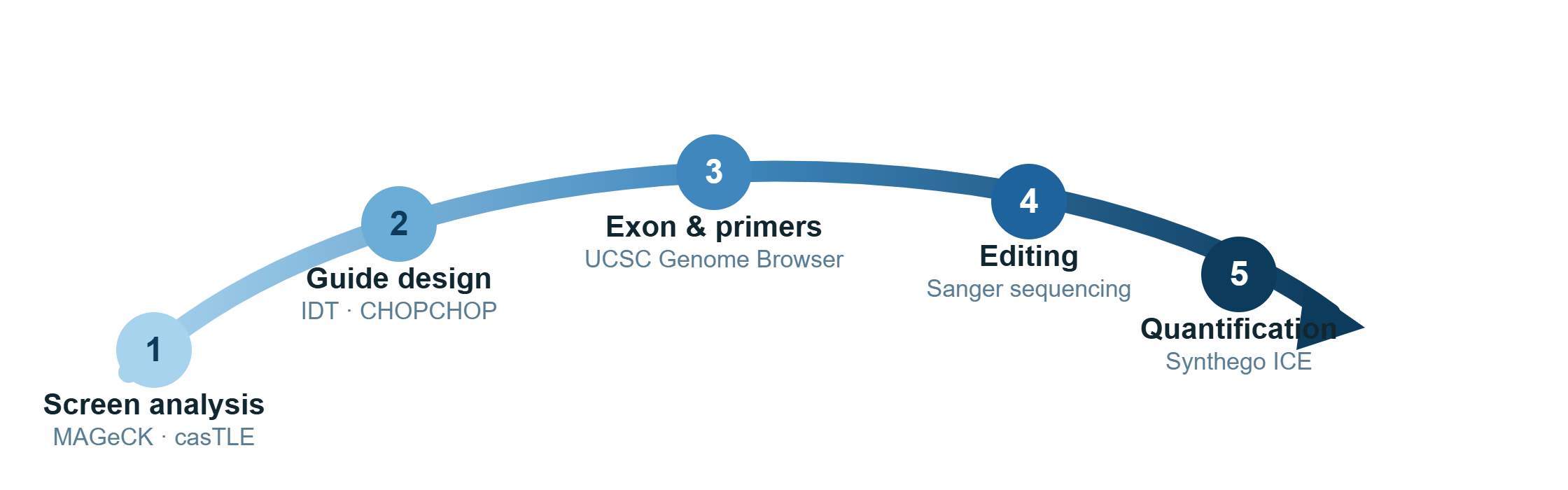
1 · Screen analysis and candidate ranking — MAGeCK + casTLE
Pooled screen data are analysed with MAGeCK, which counts sgRNAs across conditions and calls enriched and depleted genes. We use casTLE as an orthogonal, maximum-likelihood estimate of effect size, which matters in screens with lower library coverage. The output is a ranked shortlist of candidate genes rather than a single winner.
2 · Guide design and cross-checking — IDT + CHOPCHOP (CRISPick for sub-libraries)
For each candidate we design guides with the IDT Alt-R CRISPR-Cas9 design tool and with CHOPCHOP, and we keep the guides that both rank well. The two tools use different on-target scoring and different off-target searches, so agreement between them is a far better filter than either score alone. When we need a custom sub-library rather than individual guides, we design it with the Broad GPP sgRNA Designer (CRISPick), the same rule set used to build the Brunello and Brie libraries.
3 · Exon and primer verification — UCSC Genome Browser
Before ordering anything, every guide is checked against the UCSC Genome Browser. We confirm that the cut site falls in an exon shared by the relevant transcript isoforms — not in an isoform-specific or rarely included exon, the most common reason a “knockout” still expresses protein — and we design the detection primers flanking the cut site in the same view.
4 · Editing and Sanger sequencing
After transfection or transduction and selection, the targeted region is amplified with those primers and sequenced by Sanger. No clone moves forward on antibiotic resistance alone.
5 · Quantification of editing — Synthego ICE
Chromatograms are deconvoluted with Synthego ICE, which gives the full indel spectrum and a knockout score from a single Sanger read — enough to decide which clones are worth expanding, without going to deep sequencing.
The result: a validated, sequence-verified line, with the edit characterised rather than assumed.
What we can do for your project
The lab is fully equipped to work with plasmid and lentiviral constructs to modify the genome of mammalian cells at any desired location. Timelines below are for human cell lines that grow well in culture; primary and hard-to-transfect cells take longer.
1. CRISPR vector construction
Around 2 weeks
A customised CRISPR plasmid carrying a synthetic guide RNA complementary to your target site, including design and targeting strategy. Validated for nuclease efficiency by co-infection with Cas9-Blast and Sanger sequencing.
2. Single-gene knockout lines
6–8 weeks
From transduction to a clonal, sequence-verified knockout line. No clone moves forward on antibiotic resistance alone — every one is confirmed by Sanger sequencing.
3. Genome-wide screens
GeCKO & SAM libraries
Loss- and gain-of-function screens covering 19,000–23,400 genes, from library amplification and titration to sequencing, MAGeCK analysis and a ranked shortlist of candidate hits.
4. Point mutations and knock-in
6–8 weeks
Introduction of a specific variant, or repair of a patient mutation, using single-stranded oligonucleotide donors. This is how we build cellular models of genetic disease for functional validation and drug testing.
5. Functional validation
Project-dependent
Characterisation of the models generated: proliferation, migration and invasion assays, in vitro and in vivo metastasis assays, flow cytometry and advanced cell culture.
The detail
Vectors available in the lab
- lentiGuide-Puro — customisable sgRNA from the U6 promoter, puromycin resistance from EF-1α; 3rd-generation lentiviral backbone. Carries no Cas9, so it needs a Cas9-expressing line (Lenti-Cas9-2A-Blast). Particles produced in 293T cells with pCMV-VSVg and psPAX2.
- lentiCRISPRv2-GFP — 3rd-generation lentiviral vector expressing GFP alongside Cas9 and an sgRNA cloning site.
- pSpCas9(BB)-2A-GFP — S. pyogenes Cas9 with 2A-EGFP and a cloning backbone for the sgRNA.
- pSpCas9(BB)-2A-Puro (V2.0) — S. pyogenes Cas9 with 2A-Puro and a cloning backbone for the sgRNA.
Protocol — single-gene knockout
- Transfection or lentiviral infection of the CRISPR construct into the cell line of choice (lentiGuide + Cas9-Blast, pSpCas9(BB)-2A-Puro, or pSpCas9(BB)-2A-GFP).
- Puromycin or blasticidin selection, or FACS sorting.
- Clonal expansion of the targeted line.
- PCR screening of targeted clones, followed by Sanger sequencing to verify correct targeting.
- Expansion of the validated mutant clones.
Libraries available
- Human GeCKO v2 (Addgene #1000000048) — 123,411 sgRNAs, 6 per target, covering 19,050 genes. Amplified in-house before use.
- Human CRISPR activation library (SAM, 3-plasmid system) — 70,290 sgRNAs, 6 per target, covering 23,430 genes. Also amplified in-house.
Protocol — point mutations and knock-in
We design and have synthesised a single-stranded oligodeoxynucleotide (ssODN) carrying the mutated or corrected sequence:
- Electroporation or transfection of a CRISPR guide RNA–Cas9-GFP or –Cas9-Puro plasmid together with the ssODN.
- FACS sorting or puromycin selection.
- Clonal expansion of the targeted line.
- PCR and restriction-digest screening of clones, followed by Sanger sequencing to verify the introduction or repair of the mutation.
- Expansion of the validated clones.
Databases and public resources we rely on
Before committing bench time to a candidate, we check what is already known about it in three public resources:
- DepMap — the Cancer Dependency Map. We cross-check every hit against it to separate a context-specific vulnerability from a pan-essential gene that would kill any cell line.
- BioGRID ORCS — the Open Repository of CRISPR Screens, which collects published genome-wide screens. It tells us whether a candidate has already come up in a comparable screen, and in which cell types.
- cBioPortal — for the clinical side: how often the gene is altered or differentially expressed in patient tumour cohorts, and whether that tracks with stage or outcome.
Working with us
If you are interested in a collaboration, or would like to discuss whether a CRISPR approach fits your question, get in touch. We are based at the School of Pharmacy, Universidad Complutense de Madrid.

